

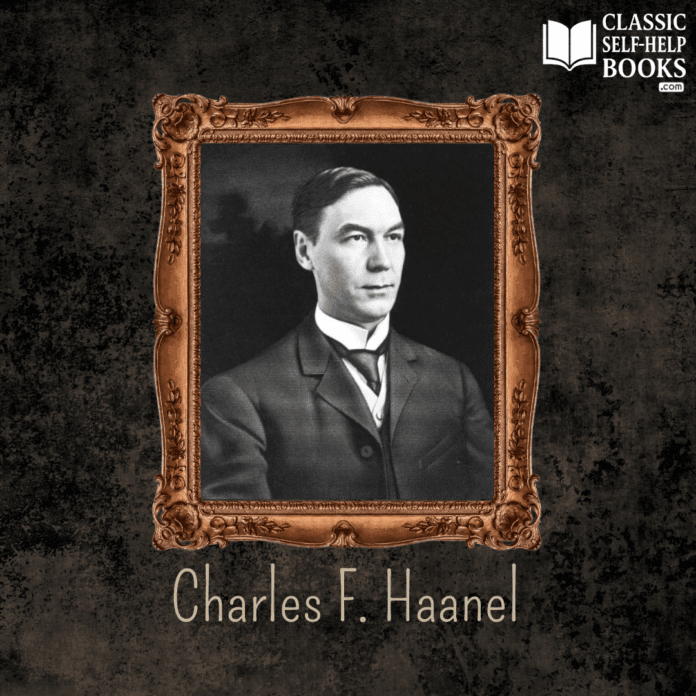
Charles F. Haanel – Architect of Mental Mastery and Systematic Success.
Charles F. Haanel (1866–1949) was an American New Thought author and mental science pioneer, best known for The Master Key System, a foundational work in self-help, visualization, and personal power.
Introduction: Charles F. Haanel and the Systematization of Success
Charles Francis Haanel occupies a central position in the evolution of modern self-help and mental science, distinguished by his effort to organize metaphysical principles into a structured, teachable system. Where earlier New Thought writers often relied on sermons or inspirational essays, Haanel approached the subject with a methodical, instructional mindset, making him one of the first architects of systematic personal development.
His work bridges philosophy, psychology, and practical instruction, anticipating many principles later popularized by motivational training, cognitive psychology, and success coaching.
Early Life and Professional Background (1866–1905)
Born in 1866 in Ann Arbor, Michigan, Charles F. Haanel pursued a career in business and law before devoting himself fully to metaphysical study and writing. His professional experiences exposed him to the dynamics of discipline, organization, and leadership, which later shaped the structured tone of his teachings.
Unlike many spiritual authors of his era, Haanel spoke from the perspective of a practical businessman, seeking results that were observable, repeatable, and internally verifiable.
Intellectual Foundations and Influences
Haanel’s thought was influenced by:
- New Thought metaphysics
- Thomas Troward’s writings on Mental Science
- Early psychology and concentration studies
- Hermetic and classical philosophical principles
He emphasized cause and effect, asserting that mental causation precedes material manifestation. His approach combined metaphysical ideals with disciplined practice, positioning the mind as both creative source and governing intelligence.
The Master Key System: Structure and Innovation
First published in 1912, The Master Key System was released as a 24-week correspondence course, a radical innovation for its time. Each lesson built progressively upon the previous one, guiding students through exercises in:
- concentration
- visualization
- mental imagery
- emotional regulation
- deliberate intention
This structured pedagogy distinguished Haanel from his contemporaries and laid the groundwork for modern online courses, coaching programs, and success curricula.
Thought, Concentration, and Creative Power
Central to Haanel’s philosophy is the idea that:
- Concentrated thought is creative force
- Mental clarity precedes effective action
- Inner harmony leads to outer order
He taught that the subconscious mind responds to clear mental images combined with emotional conviction, a concept that would later influence figures such as Napoleon Hill and Maxwell Maltz.
Wealth, Ethics, and Inner Alignment
Although frequently associated with wealth creation, Haanel repeatedly emphasized that ethical alignment and service were prerequisites for lasting success. Wealth, in his view, was a byproduct of constructive thought and value creation, not mere desire.
This ethical framing aligned him with earlier thinkers such as James Allen while retaining a pragmatic focus on achievement.
Teaching Style and Literary Voice
Haanel’s prose is:
- instructional rather than poetic
- authoritative but restrained
- precise and cumulative
His lessons often conclude with mental exercises, reinforcing the idea that knowledge must be applied to become transformative.
Later Life and Enduring Reputation
Charles F. Haanel continued writing and teaching throughout the early 20th century. Though he lived largely outside the public spotlight, his influence expanded quietly through students, successors, and later authors who adapted his methods for mass audiences.
He died in 1949, leaving behind a system that continues to inform personal development literature worldwide.
10 Famous Quotes by Charles F. Haanel
Editorial note: Quotes are drawn from published works and authoritative editions.
- “All power is from within and is therefore under our control.”
- “The world without is a reflection of the world within.”
- “Concentration is the secret of power.”
- “Thought is the energy which molds the universe.”
- “Creative power is thought power.”
- “Harmony is the law of the universe.”
- “The subconscious mind is the connecting link between the finite and the Infinite.”
- “Mind is the only reality.”
- “Success depends upon spiritual power.”
- “Mental effort becomes effective only when directed.”
Major Books by Charles F. Haanel
1. The Master Key System (1912)
His most influential work; a complete course in mental mastery and creative thought.
2. The New Psychology (1912)
Explores the subconscious mind and its role in shaping behavior and outcomes.
3. Mental Chemistry (1922)
Examines the interaction between thought, emotion, and material results.
4. The Amazing Secrets of the Yogi (1916)
Blends Eastern philosophy with Western mental science concepts.
5. A Book About You (1924)
A reflective exploration of self-knowledge and personal development.
Influence on Modern Self-Help and Mental Training
Charles F. Haanel’s work represents a turning point in the evolution of self-help, shifting from inspirational philosophy to repeatable mental training systems. His influence can be traced through:
- Napoleon Hill’s success principles
- visualization techniques in sports psychology
- modern manifestation and mindset programs
Haanel demonstrated that mental discipline is learnable, that success follows law rather than chance, and that the mind—properly trained—becomes the most reliable instrument of personal transformation. His legacy endures not through charisma, but through structure, clarity, and intellectual rigor.