
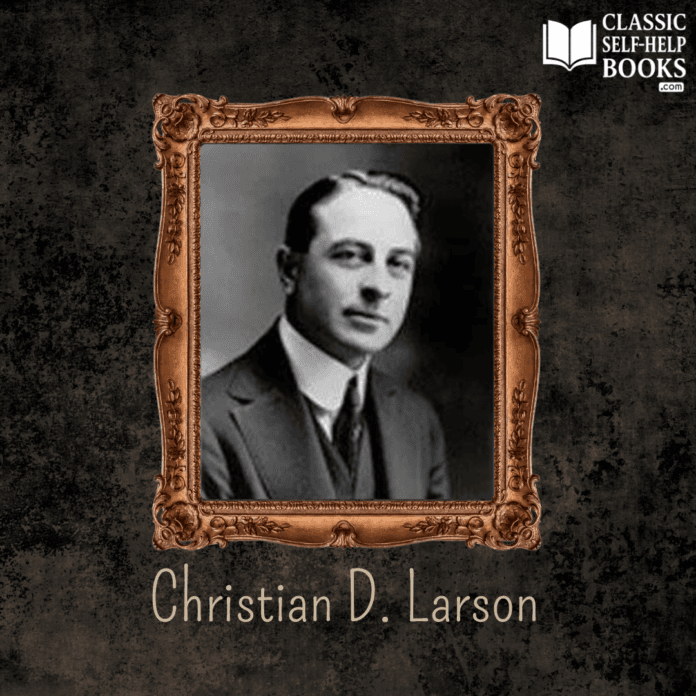
Christian D. Larson: New Thought Author and Teacher of Mental and Spiritual Mastery.
Christian D. Larson was a leading New Thought writer and lecturer whose works on mental science, self-mastery, and spiritual development influenced modern self-help philosophy. His teachings emphasize inner power, conscious thinking, and purposeful living.
Introduction: Christian D. Larson and the Architecture of Inner Power
Christian Daa Larson (1874–1954) was one of the most prolific and influential authors of the New Thought movement during the early twentieth century. As a writer, editor, and lecturer, Larson dedicated his life to exploring the relationship between thought, character, and destiny, offering readers practical guidance for developing inner strength and spiritual awareness.
Larson’s writings combine metaphysical insight with disciplined self-improvement, positioning him as a bridge between spiritual philosophy and practical personal development. His work addresses success, health, ethics, and mental mastery, emphasizing that true advancement begins with the conscious direction of thought and purpose.
Early Life and Intellectual Formation
Christian D. Larson was born in 1874 in Iowa, United States. From an early age, he demonstrated a strong interest in philosophy, psychology, and the deeper laws governing human behavior. His intellectual curiosity led him to study metaphysical systems, Eastern philosophy, and emerging psychological theories.
Larson was particularly drawn to the idea that the mind is not merely reactive, but creative, capable of shaping both character and circumstance. This conviction became the foundation of his lifelong work and placed him squarely within the evolving New Thought tradition.
Role Within the New Thought Movement
Larson emerged as a prominent voice within the New Thought movement during its period of rapid expansion in the early 1900s. He served as editor of New Thought Magazine, one of the most influential publications of the movement, and used this platform to articulate a systematic philosophy of mental and spiritual development.
While sharing core New Thought principles—such as the creative power of thought and the unity of mind and body—Larson emphasized discipline, responsibility, and continuous self-refinement. His approach appealed to readers seeking not only inspiration, but structure and intellectual rigor.
Core Philosophy: Self-Mastery and Conscious Evolution
At the heart of Larson’s teaching is the concept of self-mastery. He argued that individuals must learn to govern their thoughts, emotions, and actions in order to unlock higher levels of achievement and fulfillment.
Key elements of his philosophy include:
- The creative and directive power of thought
- The necessity of mental discipline
- The development of character as a spiritual practice
- The alignment of personal ambition with universal law
Larson believed that growth is not accidental, but the result of intentional inner work, guided by clarity of purpose and ethical awareness.
Thought, Character, and Destiny
Larson consistently emphasized the idea that thought shapes character, and character shapes destiny. According to his view, repeated patterns of thinking gradually crystallize into habits, attitudes, and ultimately life outcomes.
He encouraged readers to cultivate:
- Constructive thinking
- Emotional stability
- Intellectual expansion
- Moral integrity
By doing so, individuals could transcend limitation and participate consciously in their own evolution.
Health, Vitality, and the Mind-Body Relationship
Like many New Thought thinkers, Larson explored the connection between mental states and physical health. He taught that harmony, confidence, and inner balance support vitality, while fear and mental conflict undermine well-being.
Larson approached health as a dynamic process sustained by right thinking, purposeful living, and emotional equilibrium, anticipating later developments in holistic and integrative health philosophies.
Literary Style and Educational Approach
Christian D. Larson’s writing style is clear, structured, and intellectually engaging. Unlike more poetic or mystical authors, he favored logical progression and practical explanation, making complex metaphysical concepts accessible to a broad audience.
His books often function as manuals for mental training, combining inspiration with instruction. This balance contributed to their popularity among readers interested in both spiritual insight and tangible personal improvement.
Influence on Modern Personal Development
Larson’s influence can be seen across multiple generations of self-help and personal development literature. His emphasis on mental discipline, goal clarity, and ethical ambition resonates strongly with contemporary success psychology and leadership philosophy.
He helped establish a framework in which spiritual growth and worldly achievement are not opposites, but complementary expressions of conscious living.
Ten Famous Quotes by Christian D. Larson
- “Believe in yourself and all that you are.”
- “The mind that is constantly expanding never grows old.”
- “You are here to grow, to expand, and to unfold.”
- “Think the best, do the best, and expect the best.”
- “Every thought has a destiny.”
- “Your possibilities are as limitless as your ideals.”
- “What you live in thought, you will express in life.”
- “Strong purpose makes strong character.”
- “To master self is to master life.”
- “The soul grows through conscious effort.”
Five Major Books by Christian D. Larson
- The Law of the New Thought (1909)
- Your Forces and How to Use Them (1912)
- Mastery of Self (1918)
- Just Be Glad (1912)
- How to Stay Young (1916)
The Enduring Relevance of Christian D. Larson
Christian D. Larson’s work continues to speak to readers who seek clarity, discipline, and purposeful growth in an increasingly complex world. His teachings affirm that human potential is not a matter of chance, but of conscious development guided by universal principles.
By uniting spiritual insight with intellectual rigor and practical application, Larson left a legacy that remains deeply relevant to modern self-help, mental training, and conscious living traditions.