


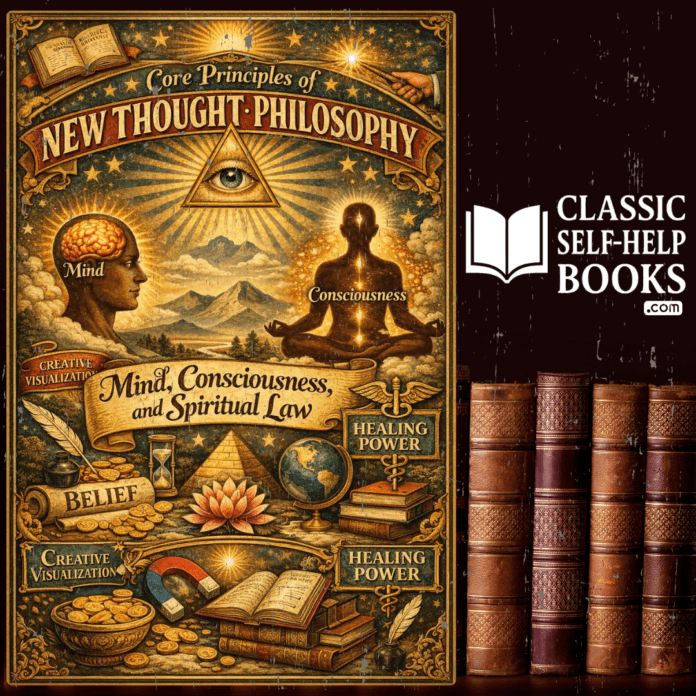
What are the core principles of New Thought philosophy?
The core principles of New Thought philosophy include the belief in a universal spiritual intelligence, the creative power of thought, mental causation, the unity of mind and body, and the operation of spiritual law. New Thought teaches that consciousness shapes experience and that individuals can improve health, prosperity, and well-being through aligned thinking and spiritual understanding.
Introduction
The New Thought Movement is not defined by dogma or ecclesiastical authority, but by a coherent set of metaphysical principles that emphasize the creative power of consciousness. Emerging in nineteenth-century America, New Thought philosophy synthesized elements of idealism, transcendentalism, metaphysics, and spiritual healing into a practical worldview centered on the mind’s role in shaping reality.
At its core, New Thought proposes that thought is causative, that spiritual laws govern life, and that human beings, through conscious awareness, may align with these laws to experience greater harmony, health, and fulfillment. These ideas profoundly influenced modern self-help literature, positive psychology, and contemporary spiritual movements.
This article examines the foundational principles of New Thought philosophy, tracing their conceptual roots and explaining their enduring relevance.
1. The Principle of Universal Mind
Definition
New Thought begins with the assertion that a Universal Mind or Infinite Intelligence underlies all existence. This intelligence is not external or distant, but immanent—present within all forms of life.
Key Concepts
- Reality originates in consciousness
- The universe is mental and intelligent
- Individual minds are expressions of a greater whole
Thinkers such as Phineas Parkhurst Quimby, Thomas Troward, and Ralph Waldo Trine articulated this principle as a metaphysical alternative to materialism. Rather than viewing matter as primary, New Thought places mind as the first cause.
This concept aligns closely with philosophical idealism and influenced later teachings in spiritual psychology and metaphysical healing.
2. The Creative Power of Thought
Does New Thought teach that thoughts create reality?
Yes. New Thought philosophy teaches that thoughts are creative forces. Persistent mental patterns influence emotional states, physical health, behavior, and external circumstances through the operation of spiritual law.
Explanation
One of the most widely recognized principles of New Thought is the belief that thoughts shape experience. This does not suggest magical thinking, but rather a structured relationship between:
- Belief systems
- Emotional responses
- Behavior patterns
- Life outcomes
Authors such as James Allen and Charles F. Haanel emphasized that disciplined thinking produces corresponding results. The mind acts as a formative agency, impressing ideas upon the subconscious, which then manifests them through action and experience.
This principle later became central to the Law of Attraction literature.
3. Mental Causation and Correspondence
Core Idea
New Thought philosophy asserts that mental states precede physical conditions. This doctrine, known as mental causation, holds that inner conditions correspond to outer experiences.
Practical Implications
- Health reflects habitual mental attitudes
- Circumstances mirror dominant beliefs
- Change begins inwardly before appearing outwardly
This idea was foundational to New Thought healing practices, which viewed illness not as punishment or chance, but as a correctable imbalance in thought and belief.
4. The Unity of Mind and Body
Metaphysical Perspective
New Thought rejects strict mind–body dualism. Instead, it teaches that mind and body function as an integrated system, governed by consciousness.
This understanding anticipated modern psychosomatic medicine and mind–body research.
Historical Context
Early New Thought practitioners observed that shifts in belief often preceded physical improvement. While not rejecting medical science, New Thought emphasized that mental harmony supports physical well-being.
This principle remains influential in holistic health and integrative medicine philosophies today.
5. The Principle of Spiritual Law
What is spiritual law in New Thought?
Spiritual law refers to universal, impersonal principles that govern mental and spiritual activity. According to New Thought, these laws operate consistently and can be consciously applied to improve one’s life.
Characteristics of Spiritual Law
- Impersonal and universal
- Reliable and consistent
- Accessible through understanding
Writers like Thomas Troward framed spiritual law in rational, almost scientific terms, arguing that spiritual principles function as predictably as physical laws when correctly applied.
6. Individual Consciousness and Responsibility
Ethical Dimension
New Thought philosophy places strong emphasis on personal responsibility. Since thought is causative, individuals are seen as active participants in shaping their experience.
This does not imply blame, but empowerment.
Key ideas include:
- Conscious choice over habitual reaction
- Self-awareness as a spiritual practice
- Responsibility paired with compassion
This ethical framework contributed to New Thought’s appeal in a rapidly modernizing society seeking autonomy and meaning.
7. The Principle of Growth Through Awareness
New Thought teaches that spiritual development occurs through expanding awareness, not adherence to fixed beliefs.
Growth is seen as:
- Progressive
- Experiential
- Individualized
This openness allowed New Thought to evolve organically, influencing diverse movements without becoming rigid or sectarian.
8. Alignment Rather Than Struggle
A distinctive feature of New Thought philosophy is its emphasis on alignment over effort. Rather than forcing outcomes, individuals are encouraged to align their thinking with spiritual law.
This principle contrasts sharply with:
- Ascetic struggle
- Fatalistic resignation
- Externalized authority
Instead, New Thought promotes cooperation with universal intelligence, resulting in greater ease and effectiveness.
9. The Practical Orientation of New Thought
Unlike purely speculative philosophies, New Thought has always emphasized application.
Core applications include:
- Mental discipline
- Affirmative prayer
- Visualization
- Ethical self-examination
This practical focus explains why New Thought became a foundation for modern self-help literature and motivational philosophy.
10. Influence on Modern Thought and Culture
The principles of New Thought philosophy influenced modern self-help, positive psychology, prosperity teachings, holistic health practices, and contemporary spiritual movements. Its emphasis on consciousness, responsibility, and spiritual law continues to shape personal development literature worldwide.
Authors such as Wallace D. Wattles, Christian D. Larson, and Ralph Waldo Trine translated abstract metaphysical ideas into accessible guidance for everyday life, ensuring the movement’s enduring relevance.
Final Reflections
The core principles of New Thought philosophy form a coherent metaphysical system grounded in the power of consciousness, the reliability of spiritual law, and the capacity of individuals to participate consciously in their own development. Far from being a historical curiosity, these ideas remain embedded in modern discussions of mindset, well-being, and personal transformation.
Understanding these principles provides essential context for exploring the authors, practices, and cultural impact of the New Thought Movement in America.
FAQ about Core Principles of New Thought Philosophy: Mind, Consciousness, and Spiritual Law
1. What are the main principles of New Thought philosophy?
The main principles include the creative nature of thought, the divine presence within all individuals, the operation of spiritual law, and the belief that consciousness determines life conditions.
2. What does New Thought mean by “Mind”?
In New Thought, Mind refers to both individual consciousness and Universal Mind—the intelligent spiritual substance from which all form and experience arise.
3. How does consciousness shape reality in New Thought?
New Thought teaches that thoughts held consistently in consciousness impress Universal Mind, which then manifests corresponding conditions in the physical world.
4. What is Spiritual Law in New Thought teachings?
Spiritual Law is the impersonal, consistent principle through which thought produces results. It operates similarly to natural law and responds to belief, feeling, and mental imagery.
5. Is the Law of Attraction part of New Thought?
Yes. The Law of Attraction is a later expression of earlier New Thought teachings regarding mental causation, attraction by resonance, and the power of belief.
6. How does New Thought explain prosperity and success?
Prosperity is viewed as a natural expression of alignment with spiritual law, clarity of purpose, constructive thinking, and inner abundance rather than external struggle.
7. What role does faith play in New Thought?
Faith is understood as mental acceptance and inner conviction, not blind belief. It is the mental attitude that allows spiritual law to operate effectively.
8. Are New Thought principles still relevant today?
Absolutely. These principles underpin much of modern personal development, mindfulness practices, and success philosophy used in business, wellness, and coaching today.