


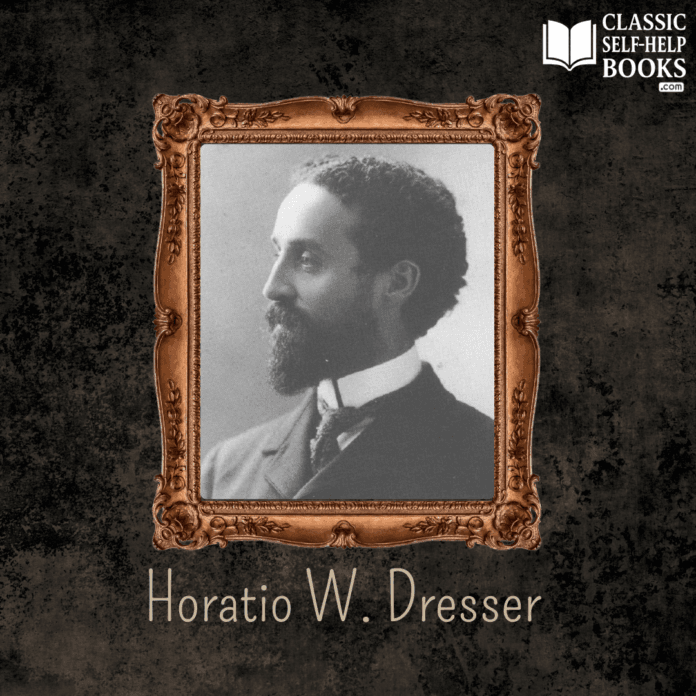
Horatio W. Dresser – Philosopher of New Thought and Interpreter of Mind, Ethics, and Religion.
Horatio W. Dresser (1866–1954) was a philosopher, author, and leading interpreter of the New Thought movement. Son of Julius A. Dresser, he expanded mental healing into a mature philosophy integrating psychology, ethics, and comparative religion.
Introduction: Horatio W. Dresser and the Maturation of New Thought Philosophy
Horatio Willis Dresser represents the second-generation intellectual flowering of the New Thought movement. Where Phineas Parkhurst Quimby discovered the principles of mental healing, and Julius A. Dresser preserved and defended them, Horatio Dresser refined, expanded, and philosophically matured those ideas for the modern world.
Unlike many New Thought writers who focused primarily on technique and affirmation, Horatio Dresser pursued a rigorous philosophical path, integrating psychology, ethics, religious studies, and emerging social sciences. His work elevated New Thought from a healing-centered movement into a comprehensive worldview, capable of engaging academic discourse while remaining accessible to the self-help reader.
Early Life and Intellectual Environment (1866–1890)
Horatio W. Dresser was born on January 15, 1866, into a household deeply immersed in metaphysical inquiry. As the son of Julius A. Dresser, he grew up surrounded by discussions of mental healing, philosophical idealism, and ethical responsibility.
From an early age, Dresser was exposed to:
- the original manuscripts of P. P. Quimby
- debates surrounding Christian Science and New Thought
- the moral dimensions of mental causation
This environment fostered a disciplined and reflective intellect rather than a purely devotional or therapeutic mindset.
Dresser pursued higher education in philosophy and theology, developing a scholarly orientation uncommon among self-help authors of his time.
Academic Formation and Philosophical Influences
Horatio Dresser’s intellectual development was shaped by:
- German idealism
- British ethical philosophy
- American pragmatism
- comparative religion
He sought to reconcile inner experience with intellectual rigor, rejecting both materialism and uncritical mysticism.
This balance positioned him uniquely as a philosopher of spiritual psychology, capable of articulating New Thought principles in language suitable for universities, lecture halls, and serious readers.
Expanding Quimby’s Legacy
While deeply respectful of Quimby’s discoveries, Dresser did not treat them as fixed dogma. Instead, he approached Quimby’s work as a starting point for philosophical inquiry.
He clarified that:
- mental healing is one application of mental law
- ethical development is equally essential
- spirituality must address social and cultural life
In this way, Dresser prevented New Thought from becoming a purely therapeutic or commercial enterprise.
Core Philosophical Contributions
1. Mind as Creative and Moral Force
Dresser emphasized that mind not only creates conditions but also carries ethical responsibility.
2. Integration of Psychology and Religion
He anticipated modern spiritual psychology by bridging inner experience and rational analysis.
3. Individual Growth Within Social Context
Unlike extreme individualists, Dresser stressed community, service, and social ethics.
4. Freedom Through Self-Knowledge
True freedom arises from understanding one’s motives, beliefs, and mental habits.
5. Religion as Experience, Not Dogma
Dresser advocated experiential spirituality grounded in reason and compassion.
Relationship to Organized Religion
Horatio Dresser maintained a respectful yet critical relationship with Christianity. He viewed religious traditions as symbolic systems pointing to universal truths, rather than exclusive authorities.
His approach influenced:
- Unity teachings
- Religious Science philosophy
- later spiritual humanism
He consistently argued that spirituality must evolve alongside knowledge and culture.
Influence on New Thought and Beyond
Dresser’s work influenced:
- New Thought educators and lecturers
- early spiritual psychologists
- ethical reformers within metaphysical movements
Though less commercially popular than later self-help authors, his influence is deep, structural, and enduring.
Contribution to Modern Self-Help Thought
Many contemporary self-help ideas resonate with Dresser’s insights:
- self-awareness as the foundation of change
- ethics as integral to success
- balance between inner life and outer responsibility
His writings challenge readers to move beyond technique toward mature self-understanding.
10 Famous Quotes by Horatio W. Dresser
Editorial note: Quotations are drawn from published works and widely cited formulations in New Thought scholarship.
- “The highest form of self-help is self-knowledge.”
- “Mind is creative, but it is also responsible.”
- “Religion must justify itself at the bar of reason.”
- “Character is the true measure of spiritual attainment.”
- “Freedom begins where unconscious habit ends.”
- “The purpose of life is growth in understanding.”
- “Spirituality divorced from ethics becomes illusion.”
- “No truth is final if it ceases to enlighten.”
- “The mind reveals itself through its choices.”
- “Healing is incomplete without moral awakening.”
Major Books by Horatio W. Dresser
1. A History of the New Thought Movement (1919)
The most authoritative historical account of New Thought, still cited by scholars.
2. The Power of Silence (1916)
Explores introspection, meditation, and inner stillness as sources of insight.
3. Human Efficiency (1909)
A bridge between New Thought, psychology, and early personal development theory.
4. Man and the Divine Order (1908)
Examines the relationship between individual consciousness and universal principles.
5. The Spirit of the New Thought (1917)
A philosophical synthesis of the movement’s core ideas and ethical implications.
Historical Role and Lasting Importance
Horatio W. Dresser died in 1954, having devoted his life to intellectual clarity, ethical depth, and philosophical integrity. He stands as the voice of maturity within New Thought, ensuring that the movement did not lose its soul to simplification or commercialism.
Through his work, New Thought became more than a method of healing—it became a philosophy of life, capable of guiding individuals toward understanding, responsibility, and meaningful self-development.