


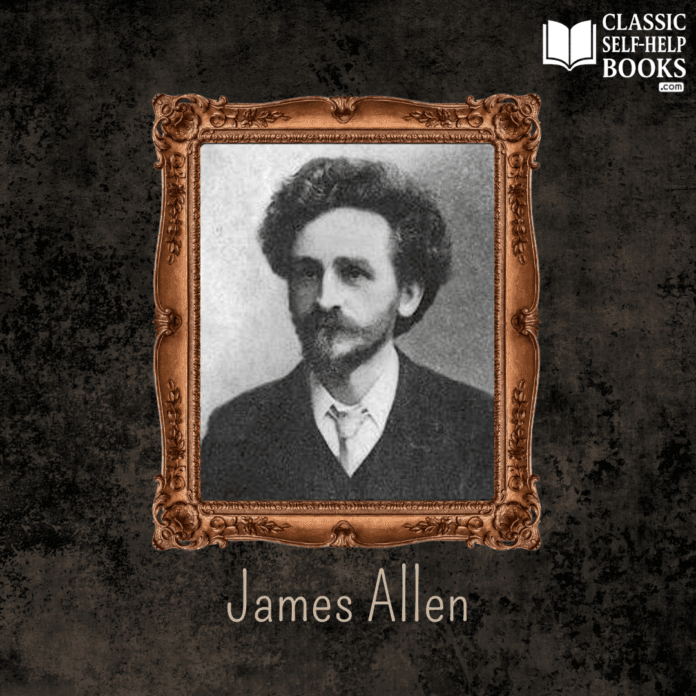
James Allen – Philosopher of Character, Thought, and Moral Self-Mastery.
James Allen (1864–1912) was a British philosophical writer and pioneer of self-help literature, best known for As a Man Thinketh. His work established the moral and mental foundations of modern personal development.
Introduction: James Allen and the Ethics of Thought
James Allen stands as one of the most influential and quietly powerful voices in the history of self-help and personal philosophy. While Thomas Troward provided the intellectual architecture of Mental Science, Allen supplied its moral compass, grounding the creative power of thought in character, responsibility, and ethical self-governance.
His writings emphasize inner discipline rather than outer control, self-purification rather than domination of circumstance. Through clarity, restraint, and philosophical depth, Allen shaped a vision of success rooted in integrity and inward mastery, rather than material excess or spectacle.
Early Life and Formative Experiences (1864–1893)
James Allen was born in 1864 in Leicester, England, into a working-class family. His early life was marked by hardship. When Allen was still young, his father traveled to America seeking opportunity but was later declared dead, leaving the family in financial and emotional distress.
Forced to leave school at an early age, Allen began working as a clerk. Despite limited formal education, he became a dedicated autodidact, immersing himself in literature, philosophy, and spiritual texts. These formative experiences instilled in him a deep understanding of personal struggle, responsibility, and the formative power of inner attitudes.
Intellectual Influences and Philosophical Orientation
Allen was influenced by:
- Stoic philosophy
- Eastern spiritual traditions
- Christian ethics (interpreted metaphysically rather than dogmatically)
- Early New Thought principles
Unlike many New Thought contemporaries, Allen rejected metaphysical excess and esoteric language. His prose is precise, restrained, and moral in tone, emphasizing self-discipline, humility, and cause-and-effect relationships between thought and life conditions.
Thought as the Root of Character and Destiny
Allen’s central philosophical insight is deceptively simple:
“A person’s thoughts shape their character, and character shapes destiny.“
In Allen’s view:
- Thought precedes action
- Action crystallizes habit
- Habit solidifies character
- Character determines circumstance
This ethical causation model positioned Allen as a bridge between moral philosophy and mental science, offering a framework that resonated deeply with readers seeking self-improvement without mysticism.
As a Man Thinketh and the Birth of Modern Self-Help
Published in 1903, As a Man Thinketh became one of the most influential self-help texts in history. Though modest in length, the book distilled Allen’s philosophy into a timeless statement on personal responsibility and mental causation.
The book asserts that individuals are not victims of fate, but architects of experience through habitual thinking. Its clarity and universality allowed it to transcend cultural, religious, and generational boundaries.
Simplicity as a Philosophical Strength
Allen believed that truth should be simple, accessible, and practical. He intentionally avoided:
- grand metaphysical claims
- promises of effortless wealth
- manipulative mental techniques
Instead, he emphasized:
- patience
- perseverance
- ethical living
- inner purification
This restraint granted his work extraordinary longevity.
The Inner Life and Spiritual Self-Mastery
Later works by Allen reveal an increasing focus on spiritual maturity, serenity, and inner peace. Success, for Allen, was incomplete without wisdom, and achievement hollow without virtue.
He consistently framed life as an inward journey, where outer results mirror inner states.
Withdrawal from Public Life
In the later years of his life, Allen withdrew from public engagement and relocated to Ilfracombe, England, where he lived a quiet, contemplative life devoted to writing and reflection.
He died in 1912 at the age of 48, leaving behind a body of work whose influence far exceeded its author’s lifetime.
10 Famous Quotes by James Allen
Editorial note: Quotes are drawn from published works and widely cited passages.
- “As a man thinketh in his heart, so is he.”
- “Circumstances do not make the man; they reveal him.”
- “You are today where your thoughts have brought you.”
- “Good thoughts bear good fruit, bad thoughts bear bad fruit.”
- “The soul attracts that which it secretly harbors.”
- “Men do not attract that which they want, but that which they are.”
- “Strong character is the outcome of self-discipline.”
- “Dream lofty dreams, and as you dream, so shall you become.”
- “Calmness of mind is one of the beautiful jewels of wisdom.”
- “Self-control is strength.”
Major Books by James Allen
1. As a Man Thinketh (1903)
The foundational self-help text on thought, character, and destiny.
2. From Poverty to Power (1901)
Explores success through character development and disciplined thinking.
3. Byways of Blessedness (1904)
A philosophical meditation on inner peace and right living.
4. The Way of Peace (1901)
Focuses on serenity, moral clarity, and spiritual composure.
5. The Mastery of Destiny (1909)
A mature synthesis of Allen’s ethical and metaphysical views.
Enduring Influence and Philosophical Legacy
James Allen’s legacy rests not on novelty, but on truth expressed with precision and moral depth. His work continues to inform leadership training, character education, mindfulness philosophy, and ethical self-help traditions worldwide.
In an era often dominated by noise and excess, Allen’s voice remains a reminder that lasting transformation begins inwardly, through disciplined thought, moral clarity, and patient self-cultivation. His writings endure because they speak not to ambition alone, but to conscience, character, and the quiet strength of the reflective mind.