

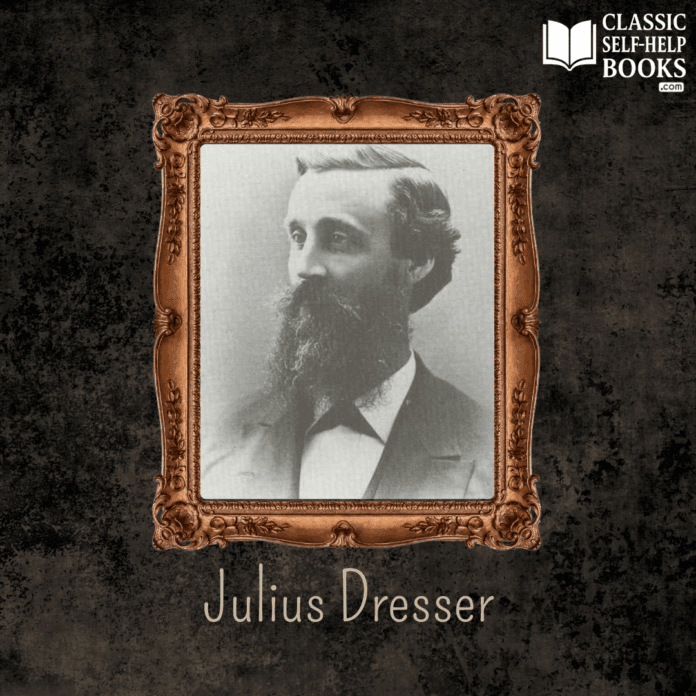
Julius A. Dresser – Historian of Mental Healing and Architect of New Thought Memory.
Julius A. Dresser (1838–1893) was a philosopher, writer, and historian of the New Thought movement. A direct student of Phineas Parkhurst Quimby, he preserved, interpreted, and disseminated the foundational principles of mental healing and mind-causation philosophy.
Introduction: Julius Dresser and the Preservation of New Thought Origins
Julius Alphonse Dresser holds a crucial yet often understated role in the history of New Thought and modern self-help philosophy. While not a system-builder in the manner of Warren Felt Evans, nor a healer-practitioner like Phineas Parkhurst Quimby, Dresser served as the primary historian, curator, and defender of Quimby’s intellectual legacy.
Without Julius Dresser, much of what is known today about Quimby’s ideas, methods, and originality might have been lost, misattributed, or misunderstood. His writings ensured that New Thought developed not only as a practical movement, but also as a historically grounded philosophy with clear intellectual lineage.
Dresser’s work is indispensable for anyone seeking an authoritative understanding of early New Thought, its ethical foundations, and its transition into self-help literature.
Early Life and Intellectual Formation (1838–1865)
Julius A. Dresser was born in 1838 in the northeastern United States, into a period of intense religious experimentation, philosophical inquiry, and social reform. Transcendentalism, Swedenborgianism, mesmerism, and alternative healing movements were actively reshaping American spiritual culture.
From an early age, Dresser exhibited a strong inclination toward philosophical reflection and historical analysis. Unlike many New Thought figures who arrived at metaphysical ideas through illness or healing crises, Dresser approached mental philosophy primarily through intellectual investigation and ethical concern.
His education emphasized literature, moral philosophy, and theology—fields that would later inform his meticulous approach to documenting New Thought history.
Encounter with Phineas Parkhurst Quimby
Dresser’s life changed profoundly when he encountered Phineas Parkhurst Quimby in the 1860s. Unlike casual observers, Dresser immediately recognized the philosophical depth of Quimby’s ideas.
He became not only a student, but also:
- a close observer of Quimby’s healing practice
- a recorder of Quimby’s explanations
- a defender of Quimby’s originality
Dresser understood that Quimby’s insights represented a paradigm shift in understanding health, consciousness, and belief.
The Role of Historian and Custodian
After Quimby’s death in 1866, disputes arose regarding the origin of mental healing ideas—particularly with the rise of Christian Science under Mary Baker Eddy.
Julius Dresser assumed a critical role:
- preserving original manuscripts
- collecting eyewitness accounts
- publishing historical clarifications
His mission was not polemical, but documentary and ethical: to ensure that credit was given where it was due and that New Thought developed with intellectual honesty.
Intellectual Philosophy and Core Themes
While Dresser is best known as a historian, his writings reveal a coherent philosophical stance.
1. Truth as Liberating Knowledge
Dresser believed truth to be inherently emancipatory, dissolving fear, ignorance, and false belief.
2. Mental Causation
He affirmed Quimby’s principle that mind precedes bodily conditions and life circumstances.
3. Ethical Use of Mental Power
Dresser emphasized responsibility, warning against manipulation, superstition, and ego-driven metaphysics.
4. Rational Spirituality
He rejected blind faith and mystical obscurity, advocating clarity, reason, and moral integrity.
These principles positioned New Thought as a constructive philosophy, not a magical system.
Contribution to New Thought Literature
Julius Dresser was among the first New Thought authors to publish explanatory and historical works, shaping how the movement understood itself.
His writings:
- clarified misconceptions
- countered sensationalism
- framed mental healing as a moral and philosophical discipline
Through Dresser, New Thought gained historical consciousness.
Relationship with Horatio Dresser
Julius Dresser’s influence extended directly to his son, Horatio W. Dresser, who would become one of the most respected philosophers and historians of New Thought in the early 20th century.
Together, father and son formed an intellectual lineage that preserved:
- Quimby’s manuscripts
- the ethical tone of early New Thought
- the philosophical seriousness of the movement
This intergenerational transmission is unique in self-help history.
Position Within the Broader Self-Help Tradition
Modern self-help often emphasizes technique over understanding. Julius Dresser represents the opposite impulse: depth over speed, truth over effect.
His work reminds readers that:
- mental power requires ethical grounding
- self-help without understanding becomes superstition
- history matters in spiritual movements
In this sense, Dresser remains a corrective voice for contemporary metaphysical culture.
10 Famous Quotes by Julius A. Dresser
Editorial note: Several quotations are drawn from historical writings and paraphrased formulations commonly cited in New Thought scholarship.
- “Truth is the only permanent healer.”
- “Mental healing rests upon understanding, not mystery.”
- “Error has no power when once it is understood.”
- “The mind creates its own limitations through belief.”
- “Spiritual growth is intellectual as well as moral.”
- “To misattribute truth is to weaken it.”
- “Healing is the result of enlightenment.”
- “The abuse of mental power leads inevitably to illusion.”
- “Religion must appeal to reason if it is to endure.”
- “The highest freedom is freedom from false belief.”
Major Books by Julius A. Dresser
1. The True History of Mental Science (1887)
The most important historical defense of Quimby’s originality and the foundational text for New Thought historiography.
2. Voices of Freedom and Studies in the Philosophy of Individuality (1888)
Explores individuality, mental liberty, and philosophical self-determination.
3. The Philosophy of P. P. Quimby (1895, posthumous)
A systematic exposition of Quimby’s ideas, preserving them for future generations.
4. Living by the Spirit (1897, posthumous)
A spiritually reflective work integrating ethics, reason, and inner development.
5. Studies in the Philosophy of Healing (compiled essays)
A collection of writings addressing mental causation and moral responsibility.
Historical Importance and Enduring Relevance
Julius A. Dresser died in 1893, leaving behind a body of work whose value has increased with time. He stands as:
- the first historian of New Thought
- the ethical guardian of mental healing
- a bridge between practice and philosophy
Through Dresser, New Thought retained memory, coherence, and intellectual dignity. His insistence on truth, attribution, and rational spirituality remains essential for anyone who seeks a serious and responsible engagement with self-help, metaphysics, and the philosophy of mind.