


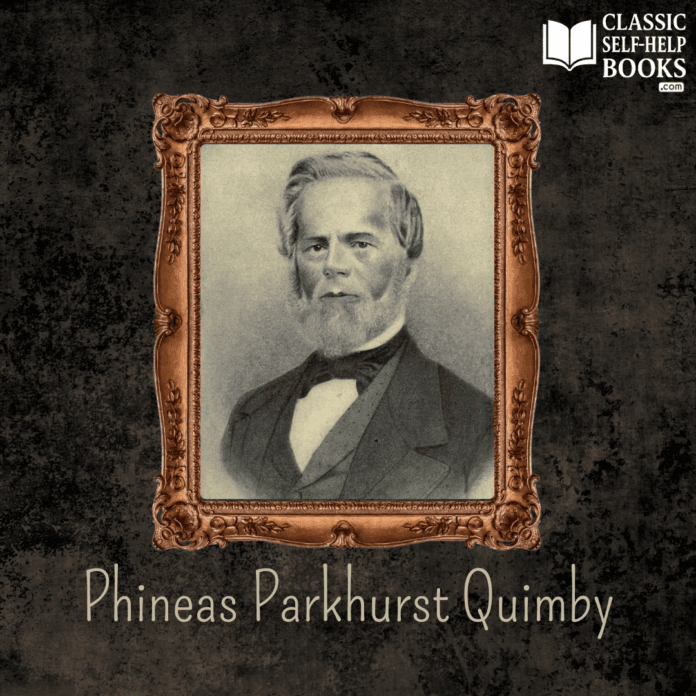
Phineas Parkhurst Quimby (1802–1866) was the founder of the New Thought movement and a pioneer of mind-body healing. His revolutionary ideas laid the foundation for modern self-help, metaphysical healing, and positive thinking philosophy in America.
Introduction: Why Phineas Parkhurst Quimby Matters Today
Phineas Parkhurst Quimby is widely recognized as the originator of the New Thought movement, a philosophical and spiritual current that profoundly shaped American metaphysical thought, modern self-help literature, and contemporary mind-body healing practices. Although he never published a formal book during his lifetime, Quimby’s ideas became the intellectual and spiritual root of countless movements, including positive thinking, mental healing, psychosomatic medicine, and the law of mind.
Today, Quimby’s influence can be traced through authors such as Emma Curtis Hopkins, Wallace D. Wattles, Charles F. Haanel, Ernest Holmes, Joseph Murphy, and Louise L. Hay. His legacy permeates modern self-help culture, affirmations, visualization techniques, and holistic approaches to health.
Understanding Quimby is essential for anyone seeking a historically grounded comprehension of self-help philosophy, New Thought metaphysics, or the origins of mind-centered healing in America.
Early Life and Background (1802–1830)
Phineas Parkhurst Quimby was born on February 16, 1802, in Lebanon, New Hampshire, into a modest working-class family. His early education was limited, largely due to chronic health issues, particularly tuberculosis, which significantly impacted his youth and shaped his lifelong interest in healing.
Despite lacking formal academic training, Quimby possessed a keen observational intelligence and a deep curiosity about the nature of illness, consciousness, and belief. His early experiences with disease would later become a central catalyst in his exploration of mental causation and healing.
In his twenties, Quimby worked as a clockmaker and inventor, demonstrating an aptitude for mechanical systems—an inclination that later influenced his analytical approach to the human mind.
Mesmerism and the Turning Point
The pivotal transformation in Quimby’s life occurred in the 1830s, when he encountered mesmerism, a form of hypnotic practice popularized by Franz Anton Mesmer. Quimby began experimenting with mesmerism not merely as a therapeutic technique, but as a window into the workings of belief, suggestion, and consciousness.
During these experiments, Quimby observed something extraordinary:
patients improved not because of physical manipulation, but because their beliefs changed.
This realization marked the beginning of Quimby’s departure from mesmerism as a method and his movement toward a radically original theory of mental causation.
The Core Insight: Mind as the Cause of Disease
Quimby’s central insight was revolutionary for its time:
“Disease is the result of false beliefs held in the mind.”
According to Quimby, illness did not originate in the body itself, but in erroneous ideas, fears, and unconscious mental patterns. The body merely expressed what the mind believed.
This concept laid the groundwork for what would later become:
- Mind-body medicine
- Psychosomatic theory
- Affirmative prayer
- Metaphysical healing
- Self-help psychology
Unlike religious dogmatism, Quimby emphasized reason, understanding, and clarity of thought as the instruments of healing.
Quimby’s Method of Healing
Quimby rejected rituals, incantations, and blind faith. His healing method was fundamentally educational.
Key Elements of His Approach:
- Diagnosis of false beliefs
- Rational explanation of mental causation
- Replacement of error with truth
- Awakening of self-awareness in the patient
Healing, for Quimby, was not something done to a patient—it was something understood by the patient.
This principle would later become a cornerstone of New Thought self-help philosophy:
transformation through conscious understanding.
Philosophy Beyond Healing
While Quimby is often remembered for his healing work, his philosophy extended far beyond health.
He proposed a non-dual view of reality, in which:
- Mind is primary
- Matter is secondary
- Truth dissolves illusion
- Freedom arises from understanding
Quimby did not promote magical thinking. Instead, he framed his ideas as a science of mind, grounded in observation, logic, and experience.
This approach strongly influenced later metaphysical systems such as:
- Science of Mind (Ernest Holmes)
- Unity teachings
- Religious Science
- Practical metaphysics
Relationship to Religion and Christianity
Quimby frequently used Christian terminology, but he rejected traditional theology. He interpreted Jesus not as a supernatural savior, but as a master teacher of mental law.
In Quimby’s view:
- Christ represented Truth
- Sin represented ignorance
- Salvation represented understanding
This metaphysical reinterpretation of Christianity would later become a defining characteristic of New Thought literature and spiritual self-help.
Mary Baker Eddy and Historical Controversy
One of the most debated aspects of Quimby’s legacy involves Mary Baker Eddy, the founder of Christian Science.
Eddy studied briefly with Quimby in the 1860s, and many scholars argue that she adopted—and later modified—his ideas. While Eddy emphasized divine revelation, Quimby emphasized rational understanding.
Despite the controversy, historical evidence confirms that Quimby’s ideas predate Christian Science and significantly influenced its early development.
Writings and Posthumous Publications
Quimby never published a book during his lifetime. His teachings survived through:
- Manuscripts
- Letters
- Patient notes
- Transcriptions by followers
After his death in 1866, his students compiled his writings into collections such as:
- The Quimby Manuscripts
- The Complete Writings of Phineas Parkhurst Quimby
These texts became foundational documents for New Thought authors who followed.
Influence on the New Thought Movement
Quimby is universally regarded as the intellectual progenitor of New Thought.
His students and intellectual descendants include:
- Warren Felt Evans
- Julius and Horatio Dresser
- Emma Curtis Hopkins
Through these figures, Quimby’s ideas spread into:
- Self-help literature
- Motivational philosophy
- Spiritual psychology
- Holistic healing
Virtually every major New Thought author can be traced back to Quimby’s original insights.
Quimby and Modern Self-Help
Modern self-help concepts such as:
- “You create your own reality”
- “Beliefs shape outcomes”
- “Healing begins within”
- “Change your thinking, change your life”
all find their historical origin in Quimby’s work.
Authors like Napoleon Hill, Norman Vincent Peale, Joseph Murphy, and Louise Hay echo principles that Quimby articulated decades earlier—often without direct attribution.
Legacy and Cultural Impact
Phineas Parkhurst Quimby died on January 16, 1866, largely unrecognized by the broader public. Yet his influence has only grown with time.
Today, Quimby is acknowledged as:
- The founder of New Thought
- A pioneer of mind-body healing
- A precursor to modern psychology
- A foundational figure in self-help philosophy
His ideas continue to shape contemporary wellness culture, coaching methodologies, and spiritual development programs.
The Silent Architect of Self-Help
Phineas Parkhurst Quimby remains one of the most important—and least understood—figures in the history of American self-help and spiritual philosophy.
Without Quimby:
- There would be no New Thought
- No positive thinking movement
- No modern metaphysical healing
- No foundational self-help philosophy as we know it
He was not a guru, prophet, or motivational speaker—but a clear-minded observer of consciousness whose insights quietly transformed modern thought.
Phineas Parkhurst Quimby – Famous Quotes
- “Disease is the effect of an error in belief.”
- “The truth is the cure.”
- “Man is made up of truth and belief, and belief is what makes disease.”
- “If I can change the mind, I can change the condition.”
- “The explanation is the cure.”
- “Sickness is the shadow of a false idea.”
- “The mind acts on the body in the same way that light acts on darkness.”
- “My practice is not faith, but knowledge.”
- “A person is sick because he believes he is.”
- “The trouble is not in the body, but in the mind’s belief about the body.”