


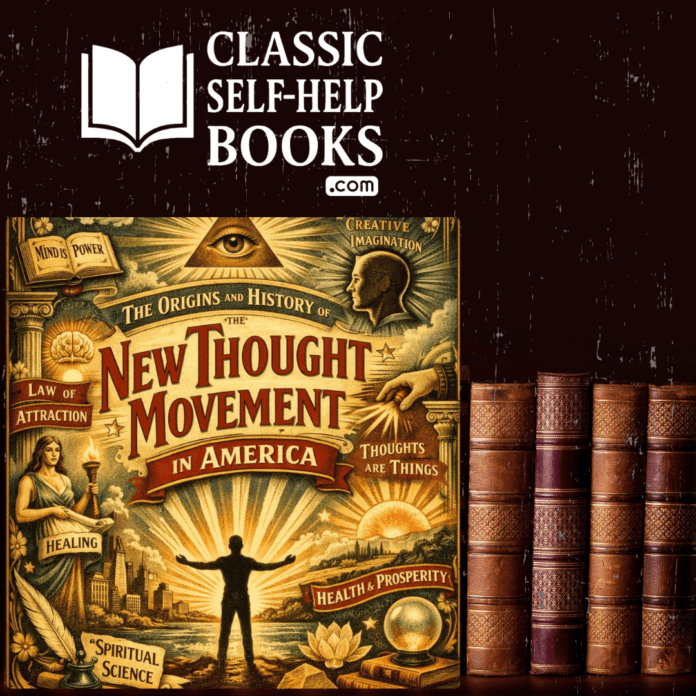
What is the New Thought Movement and how did it originate in America?
The New Thought Movement is a spiritual and philosophical movement that originated in the United States during the mid-19th century. It emerged from the healing teachings of Phineas Parkhurst Quimby and developed through the integration of metaphysics, transcendentalism, idealist philosophy, and spiritual healing. New Thought emphasizes the power of mind, mental causation, and spiritual law as the foundation for health, prosperity, and personal transformation.
Introduction: Why the New Thought Movement Still Matters Today
The New Thought movement represents one of the most influential yet frequently misunderstood intellectual traditions in American history. Emerging in the late nineteenth century, New Thought introduced a radical idea that would later become foundational to modern self-help, personal development, and holistic wellness: the human mind is not merely reactive to life—it is creative.
Long before concepts such as mindset training, positive psychology, and manifestation entered popular discourse, New Thought thinkers were articulating a philosophy in which thought precedes experience, consciousness shapes reality, and inner harmony determines outer conditions. The movement did not arise as a religion in the traditional sense, nor as a purely philosophical school, but as a practical metaphysical system concerned with health, prosperity, character, and purposeful living.
Understanding the origins and historical development of New Thought is essential for anyone seeking to grasp the deeper roots of contemporary self-help culture. Many modern teachings borrow heavily from New Thought while stripping away its ethical, philosophical, and historical context. This article restores that context by tracing the movement from its beginnings to its enduring legacy.
The Intellectual and Cultural Climate of 19th-Century America
The New Thought movement did not emerge in isolation. It arose within a fertile intellectual environment shaped by profound cultural, scientific, and spiritual transformations in nineteenth-century America.
The decline of rigid religious orthodoxy, combined with the rise of Transcendentalism, German idealist philosophy, and early psychological inquiry, created a climate in which alternative views of mind and reality could flourish. Thinkers such as Ralph Waldo Emerson emphasized self-reliance, intuition, and the divinity within the individual—ideas that strongly prefigured New Thought principles.
At the same time, rapid industrialization and urbanization generated widespread anxiety about health, meaning, and personal agency. Conventional medicine was often ineffective or dangerous, prompting many Americans to explore mental healing, spiritual remedies, and non-traditional approaches to well-being.
Within this context, New Thought emerged as a response to both materialism and dogmatism, offering a vision of life grounded in mental causation, spiritual law, and conscious self-direction.
Phineas Parkhurst Quimby: The Foundational Figure

At the heart of New Thought’s origin stands Phineas Parkhurst Quimby (1802–1866), widely regarded as the movement’s intellectual progenitor. Though Quimby never founded an organization nor formalized a doctrine, his insights laid the groundwork for everything that followed.
Originally trained as a clockmaker and inventor, Quimby became fascinated with mesmerism and the relationship between belief and physical symptoms. Through years of observation and experimentation, he arrived at a revolutionary conclusion: many illnesses are rooted in erroneous beliefs rather than physical causes.
Quimby rejected both material medicine and religious superstition. Instead, he proposed that disease originates in the mind and can be resolved through correct understanding. His healing work focused on helping patients recognize and abandon false beliefs, thereby restoring mental harmony and physical health.
Crucially, Quimby viewed truth as impersonal and universal, not dependent on faith or ritual. This emphasis on mental causation, rational inquiry, and experiential verification distinguishes him sharply from later religious movements that attempted to claim his legacy.
From Mental Healing to Mental Science
Following Quimby’s death, his ideas began to circulate through students, manuscripts, and lectures. What began as a healing practice gradually evolved into a broader philosophical system known variously as Mental Science, Mind Cure, and eventually New Thought.
This transition marked a significant shift. Early practitioners moved beyond healing illness to address character development, prosperity, emotional well-being, and purposeful living. Thought was no longer viewed solely as a cause of disease, but as the creative force shaping every aspect of human experience.
During this period, New Thought began to differentiate itself from Christian Science. While both emphasized mental healing, New Thought rejected theological absolutism and insisted on intellectual freedom, ethical responsibility, and openness to philosophical inquiry.
The First Generation of New Thought Thinkers
Warren Felt Evans

Warren Felt Evans (1817–1889) played a critical role in transforming Quimby’s insights into a coherent philosophical framework. Trained as a minister and deeply influenced by idealist philosophy, Evans interpreted mental healing through a psychological and metaphysical lens.
His writings introduced clarity, structure, and philosophical depth to Quimby’s ideas, emphasizing mental causation, consciousness, and spiritual law. Evans helped shift New Thought from anecdotal practice to intellectual movement.
Julius and Horatio W. Dresser

Julius Dresser and his son Horatio W. Dresser were instrumental in preserving and disseminating Quimby’s legacy. Julius worked directly with Quimby, while Horatio became one of the most important historians and educators of the movement.

Horatio Dresser’s scholarly approach helped legitimize New Thought as a serious philosophical tradition, documenting its origins and defending it against misrepresentation.
New Thought Becomes a Movement
By the late nineteenth century, New Thought had evolved into a recognizable movement with lectures, study groups, publications, and correspondence courses. Unlike traditional religions, it lacked centralized authority or dogma, allowing for diversity of interpretation.
Magazines such as New Thought, Expression, and Unity played a crucial role in spreading ideas across the United States and beyond. Lecturers traveled extensively, and New Thought centers emerged in major cities.
This decentralized structure proved to be one of New Thought’s greatest strengths, enabling adaptability, innovation, and broad appeal.
Core Principles That Unified New Thought
Despite its diversity, New Thought was unified by several foundational principles:
- Thought is creative and causative
- The mind influences health, character, and circumstance
- Inner harmony produces outer order
- The universe operates according to spiritual law
- Individuals are responsible for their mental states
These principles formed the philosophical backbone of later self-help teachings, often without attribution.
The International New Thought Alliance
Founded in 1914, the International New Thought Alliance (INTA) sought to provide a cooperative framework for the movement while preserving its non-dogmatic spirit.
Rather than enforcing orthodoxy, the INTA emphasized shared values, ethical conduct, and educational exchange. It helped formalize New Thought as a cultural and philosophical tradition without transforming it into a rigid institution.
New Thought and the Birth of Modern Self-Help
The transition from metaphysical philosophy to modern self-help occurred through authors who translated New Thought principles into accessible, practical systems .
Figures such as James Allen, Wallace D. Wattles, Charles F. Haanel, Ralph Waldo Trine, and Christian D. Larson reframed mental causation in terms of success, discipline, purpose, and prosperity.
Their books introduced concepts that remain central today:
- Mindset determines outcomes
- Habitual thought shapes destiny
- Success follows law, not luck
- Ethics and inner alignment matter
Modern classics such as Think and Grow Rich and contemporary manifestation teachings trace directly back to these New Thought foundations.
New Thought vs. Other Spiritual Movements
New Thought differs fundamentally from:
- Christian Science, which adopted rigid theological claims
- Traditional Christianity, which emphasized salvation over self-mastery
- New Age spirituality, which often lacks philosophical rigor
New Thought insists on personal responsibility, rational inquiry, and practical results, positioning it as a philosophy of conscious living rather than belief.
Criticism and Misunderstandings
Critics have accused New Thought of promoting naïve optimism or blaming individuals for misfortune. Early New Thought authors responded by emphasizing ethical responsibility, compassion, and social context.
Misinterpretations often arise when New Thought principles are reduced to slogans or stripped of their philosophical grounding.
The Legacy of New Thought in the Modern World
Today, New Thought continues to influence:
- Positive psychology
- Coaching and leadership training
- Mindfulness and holistic health
- Conscious entrepreneurship
Its ideas persist precisely because they address enduring human concerns: meaning, agency, health, and fulfillment.
Why Understanding New Thought History is Essential
Understanding the historical roots of New Thought restores depth, nuance, and ethical grounding to modern self-help. It reveals that personal development was never intended as mere material gain, but as integrated growth of mind, character, and purpose.
A Living Intellectual Tradition
The New Thought movement is not a relic of the past, but a living intellectual tradition. Its history reveals a sustained effort to understand the laws of mind and apply them wisely to life. By returning to its origins, readers rediscover a philosophy that unites inner mastery with outward effectiveness, offering a timeless framework for conscious and meaningful living.
FAQ about The Origins and History of the New Thought Movement in America
1. What is the New Thought Movement?
The New Thought Movement is a spiritual and philosophical tradition that emerged in the United States during the 19th century, emphasizing the power of mind, positive thinking, and spiritual law in shaping health, prosperity, and personal fulfillment.
2. When did the New Thought Movement begin?
The movement originated in the mid-1800s, with its earliest roots traced to the teachings of Phineas Parkhurst Quimby, whose ideas on mental healing influenced many later New Thought leaders.
3. Who founded the New Thought Movement?
There is no single founder, but Phineas Parkhurst Quimby is widely regarded as the primary philosophical source. The movement evolved through multiple writers, teachers, and organizations rather than a centralized authority.
4. How is New Thought different from traditional religion?
New Thought focuses on metaphysical principles and personal spiritual practice rather than dogma or institutional worship. It emphasizes direct experience, mental causation, and universal spiritual laws.
5. What role did mental healing play in early New Thought?
Mental healing was central to early New Thought teachings, proposing that illness originates in erroneous beliefs and can be corrected through right thinking and spiritual understanding.
6. How did New Thought spread across America?
The movement expanded through lectures, metaphysical churches, correspondence courses, magazines, and widely distributed self-help books in the late 19th and early 20th centuries.
7. Is New Thought connected to modern self-help?
Yes. New Thought directly influenced modern self-help, personal development, and success literature, shaping ideas still found in contemporary motivational and mindset-based teachings.
8. What are the core principles of New Thought philosophy?
Key principles include the creative power of thought, the unity of mind and spirit, the existence of universal spiritual law, and the idea that consciousness shapes experience.