

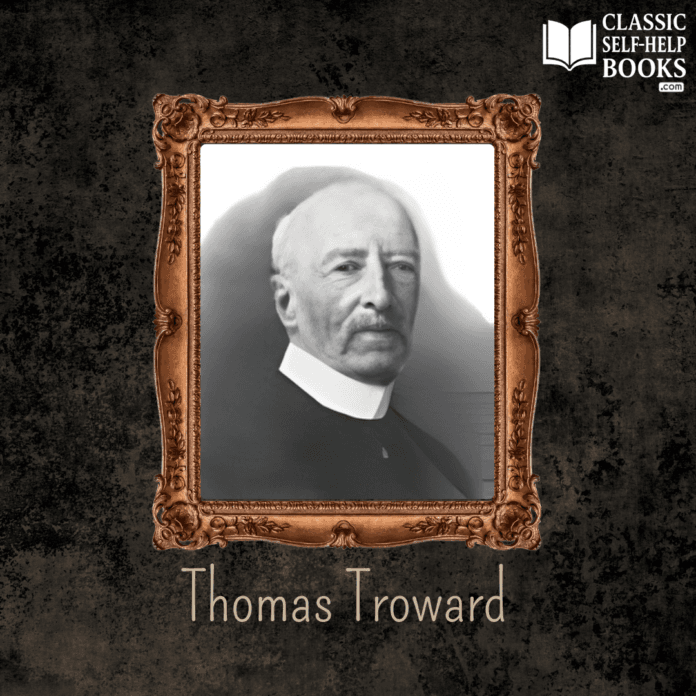
Thomas Troward – Architect of the Mental Science Philosophy and Master Theorist of Creative Mind.
Thomas Troward (1847–1916) was a British judge, philosopher, and leading theoretician of the New Thought movement. His rigorous formulation of Mental Science shaped modern self-help, the law of attraction, and creative mind philosophy.
Introduction: Thomas Troward and the Intellectual Apex of New Thought
Thomas Troward occupies a singular position in the history of New Thought and modern self-help philosophy. While earlier figures such as Phineas Parkhurst Quimby discovered mental causation through healing practice, and writers like Warren Felt Evans and the Dresser family systematized and preserved those insights, Troward elevated New Thought to its highest level of philosophical precision and logical rigor.
Often described as the “philosopher’s philosopher” of Mental Science, Troward provided the conceptual architecture upon which much of twentieth-century self-help was built. His work directly influenced figures such as Genevieve Behrend, Ernest Holmes, Charles F. Haanel, and Neville Goddard, and indirectly shaped the modern discourse surrounding the law of attraction and creative visualization.
Early Life and Professional Formation (1847–1890)
Thomas Troward was born in 1847 in England and educated within the British legal tradition. He pursued a career in law and eventually became a judge in the British colonial service, serving primarily in India.
This legal background profoundly influenced his intellectual style. Troward approached philosophy not as speculation, but as a discipline requiring internal consistency, logical coherence, and demonstrable principles. His exposure to Eastern philosophy during his years in India further enriched his worldview, introducing him to non-dual concepts of consciousness and universal mind.
Unlike many New Thought writers, Troward did not emerge from a healing crisis or religious conversion. His entry into metaphysical philosophy was purely intellectual, driven by a search for first principles underlying mind, matter, and causation.
Transition from Law to Philosophy of Mind
Upon retiring from judicial service, Troward devoted himself to the study of metaphysics, psychology, theology, and philosophy. He began delivering lectures on what he termed Mental Science, aiming to establish it as a true science of mind, governed by universal and impersonal laws.
Troward rejected vague mysticism and emotional religiosity. He sought a framework in which:
- mind operates according to law
- consciousness is creative
- individual thought participates in universal intelligence
This approach distinguished him sharply from popular motivational writers and positioned his work as foundational rather than derivative.
Core Philosophical Insight: The Creative Process of Mind
Troward’s central contribution lies in his formulation of the Creative Process of Mind, a systematic explanation of how thought becomes form.
According to Troward:
- Universal Mind is infinite, creative, and impersonal
- Individual mind is a focalization of Universal Mind
- Thought impressed upon mind produces corresponding conditions
- Mind acts deductively, accepting impressions without contradiction
This model provided New Thought with its most logically defensible explanation of manifestation, healing, and self-directed change.
Individuality and the Universal Principle
One of Troward’s most important clarifications was the relationship between individuality and universality.
He rejected:
- ego-driven personal will
- coercive mental control
- magical manipulation
Instead, he emphasized alignment with principle, not domination of outcomes. True power, for Troward, arose from understanding how Universal Mind works and thinking in harmony with it.
This distinction profoundly influenced later ethical formulations of self-help.
Mental Science Versus Blind Faith
Troward consistently distinguished Mental Science from faith-based religion. He argued that:
- faith without understanding leads to superstition
- law, once understood, can be consciously applied
- knowledge empowers consistency and responsibility
This position appealed to readers seeking spirituality without dogma and remains one of the strongest intellectual pillars of self-help philosophy.
Influence on New Thought Leaders
Troward’s impact is visible across the entire twentieth-century metaphysical landscape.
He directly influenced:
- Genevieve Behrend, his student and authorized interpreter
- Ernest Holmes, founder of Science of Mind
- Charles F. Haanel, author of The Master Key System
His ideas also resonate strongly in the works of Neville Goddard, particularly regarding imagination and assumption.
Contribution to Modern Self-Help
Many concepts now central to self-help trace directly to Troward:
- creative visualization
- mental causation as law
- alignment with universal intelligence
- disciplined thought practice
While later authors simplified and popularized these ideas, Troward provided their philosophical backbone.
10 Famous Quotes by Thomas Troward
Editorial note: Quotes are drawn from published works and commonly cited passages in Mental Science literature.
- “The universal mind must act according to the nature impressed upon it.”
- “Spirit is the originating power of all things.”
- “Thought is the starting point of every form.”
- “The law works with mathematical exactness.”
- “You cannot impress the subconscious with a negative.”
- “The creative power of thought is deductive, not selective.”
- “Individuality is the true manifestation of the universal.”
- “We must think in principles, not in personalities.”
- “The spiritual power is always creative, never destructive.”
- “Right thinking is alignment with law.”
Major Books by Thomas Troward
1. The Edinburgh Lectures on Mental Science (1904)
The definitive exposition of Mental Science philosophy and the cornerstone of his legacy.
2. The Dore Lectures on Mental Science (1909)
Further clarification and refinement of the Creative Process of Mind.
3. The Creative Process in the Individual (1915)
Explores individuality, creativity, and the personal application of mental law.
4. Bible Mystery and Bible Meaning (1913)
A metaphysical interpretation of biblical symbolism aligned with Mental Science.
5. The Law and the Word (1912)
Examines the relationship between spoken word, thought, and manifestation.
Historical Significance and Enduring Authority
Thomas Troward died in 1916, leaving behind a body of work that remains unsurpassed in logical rigor within New Thought literature. He stands as the architect of Mental Science, providing a philosophical structure strong enough to support generations of self-help teaching.
His insistence on clarity, law, and principle continues to distinguish serious mental science from superficial motivation. For readers seeking depth, precision, and intellectual integrity, Troward remains an essential guide to understanding how mind, law, and creativity intersect in human experience.